The Digital Shift: Moving from Old School Marketing to AI-Powered Growth
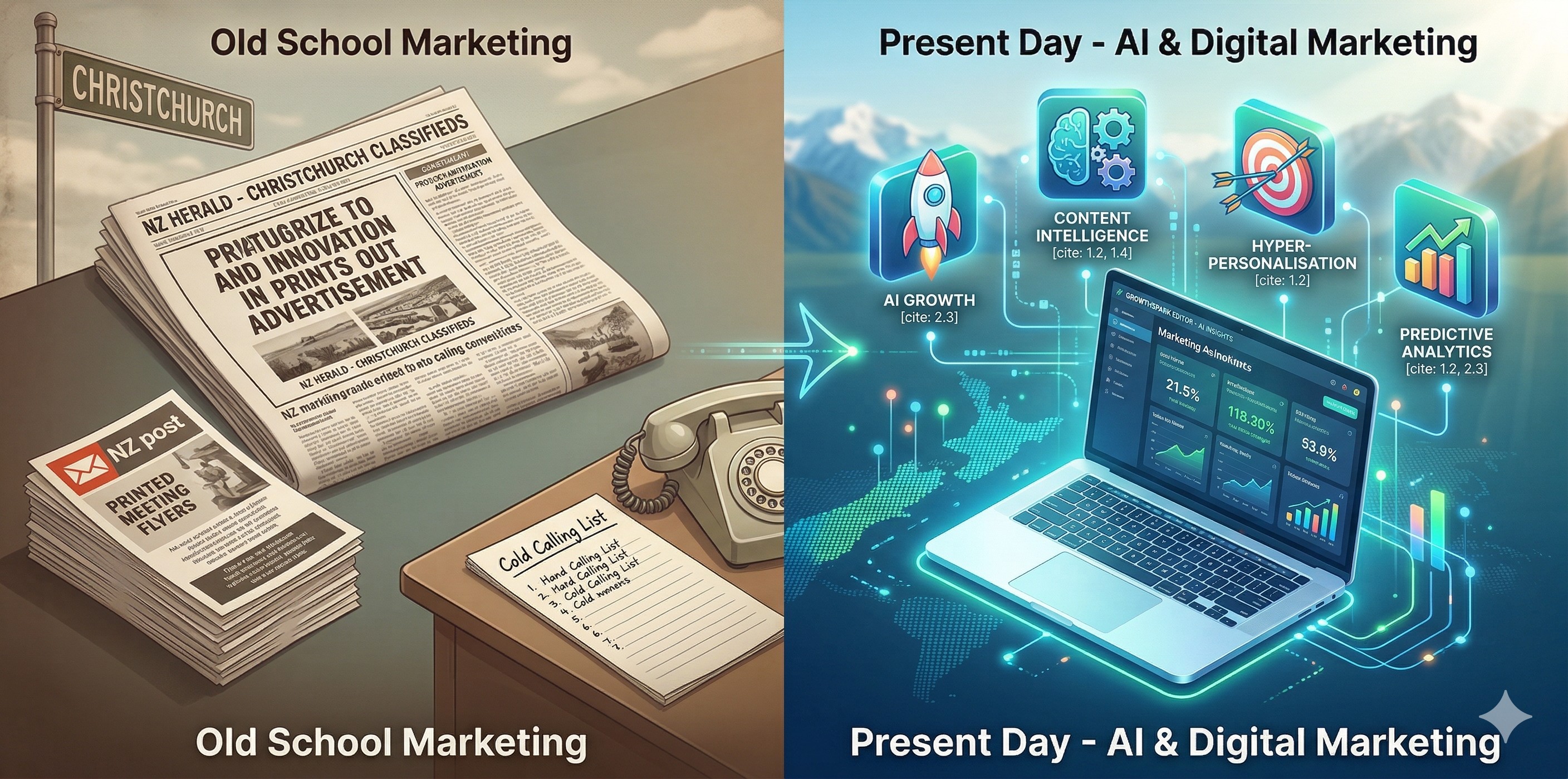
Remember the days when marketing a business meant booking ad space in the local newspaper, printing physical flyers to stuff into mailboxes, and relying on cold calls to find new clients? It was a time of broad strokes and hopeful outreach, where measurement was difficult, and personalisation was almost impossible.
If you’re still relying only on those methods, you’re missing a massive opportunity. The marketing landscape has not just changed; it has been entirely rewritten. Today, the most successful businesses aren’t just using technology; they are partnering with it.
We are living in the age of intelligent marketing, and the primary driver of this revolution is Artificial Intelligence (AI).
The Old vs. The New: A Comparative Look
Let's break down the core differences.
| Feature | Old School Marketing | Present Day (AI-Powered) Marketing |
|---|---|---|
| Audience Targeting | Broad. E.g., "Everyone in Christchurch." | Hyper-Specific. E.g., "People in Christchurch interested in 'organic coffee', who have visited my website in the last 30 days, and are active online between 6 PM and 9 PM." |
| Content Creation | Manual, time-consuming. Relies heavily on human copywriters and designers for every single variation. | Augmentative and automated. Human ingenuity guides AI tools to generate 100 variations of ad copy, social media posts, and blog outlines in minutes. |
| Measurement | Difficult and slow. Did the newspaper ad work? You might know in a few weeks if sales went up, but it's hard to be sure. | Instant and precise. You know exactly how many people saw your ad, clicked it, and purchased, in real-time. |
| Response Time | Days or weeks to adjust a campaign. | Seconds. An AI system can automatically shift budget away from underperforming ads and toward successful ones instantly. |
How AI is Redefining Marketing
It's easy to hear terms like "AI tools" and dismiss them as more marketing 'bla bla bla'. But the shift is tangible and powerful. The technology is no longer science fiction; it’s a standard business necessity.
Here’s how AI tools are actually working behind the scenes right now:
- Content Intelligence: Instead of struggling with writer's block, marketers use AI like ChatGPT (the 'bla bla bla' tool of our era) to generate dozens of catchy email subject lines or blog topic ideas based on current search trends. AI doesn't replace the human; it removes the 'blank page' barrier.
- Predictive Customer Journeys: In the past, we had to guess what a customer wanted next. Now, AI can analyze a user’s behavior on your website—what they clicked, how long they stayed—and predict what product or information they need next, serving it to them before they even ask. This is personalisation on a scale never before possible.
- Visual Automation: Need a high-quality product image? In the past, that required a studio session. Today, AI can take a basic product photo and generate multiple variations with different backgrounds and lighting in seconds. Need a simple graphic? AI can generate illustrations based on a simple text description (like the image below!).
- Performance Optimisation: The single greatest change. AI algorithms manage digital ad campaigns. They test 50 different images, 20 different headlines, and 10 different audiences simultaneously. They figure out which combination is winning and automatically allocate your budget to the best performer, all while you sleep.
The Future of Your Business
The most important takeaway is that human creativity and AI automation are not competitors; they are partners.
A modern marketing strategy uses AI to handle the heavy, repetitive 'bla bla bla' work (data analysis, A/B testing, initial content drafting), freeing up the business owner and the marketing team to focus on high-level strategy, authentic brand storytelling, and building real connections with clients.
If you’re still marketing like it's 2010, the "digital shift" isn't just a trend you can ignore—it's the new reality of survival and growth.